
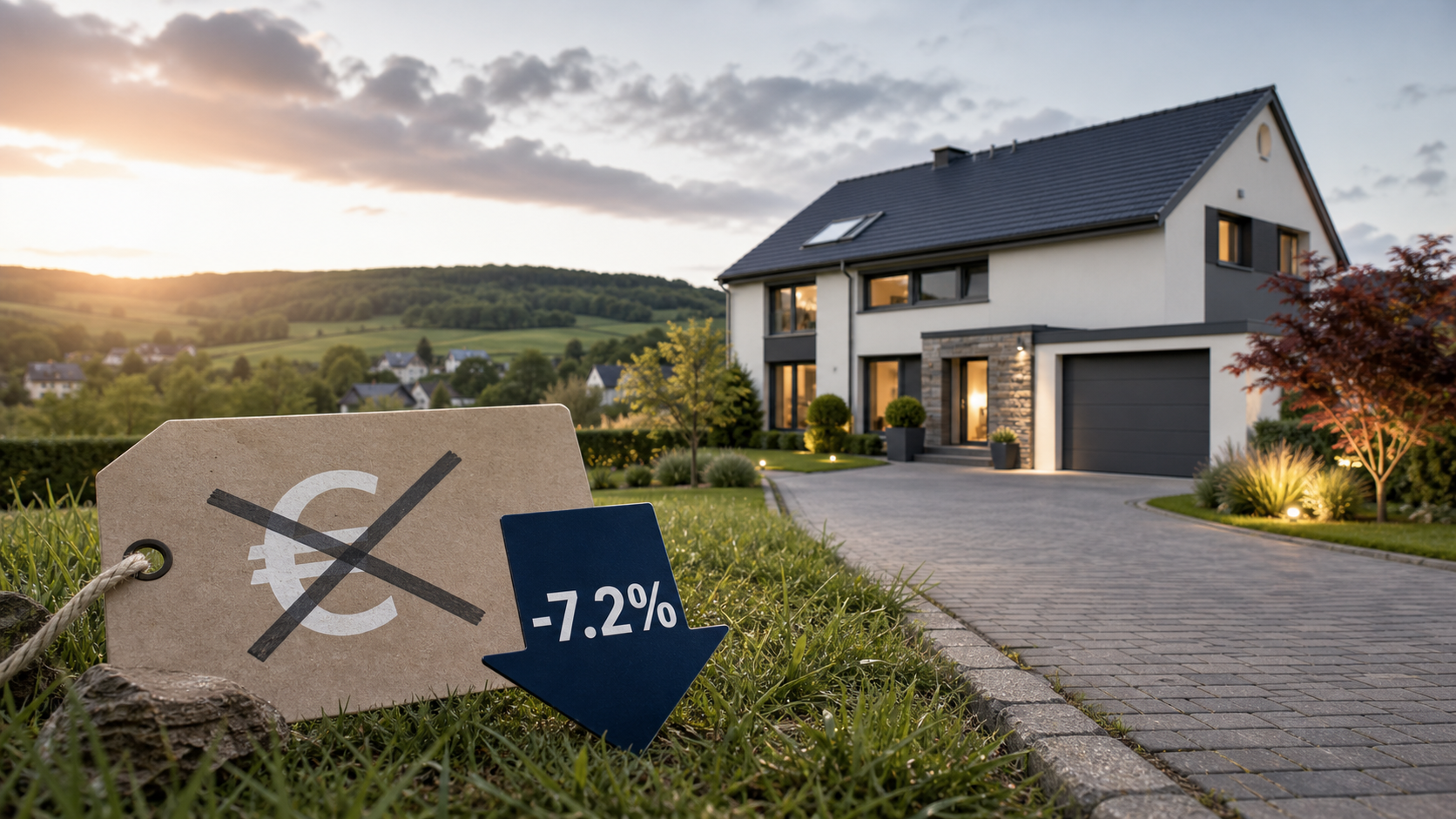
Asking price vs selling price in Luxembourg: the 7% gap (52,000 €) sellers underestimate
Get your price range instantly, on screen, in 2 minutes. Free and without obligation. The precise valuation then takes place on site.
See my price range now
The Luxembourg market in 2026: what the official figures say
After the strong rise from 2015 to 2022, the 2023-2024 correction and the 2025 rebound driven by temporary tax measures, the market has entered a phase of normalisation. In Q1 2026, STATEC's hedonic house price index rose +0.7% over the quarter and +1.7% over twelve months, a pace now close to inflation (+1.6%).
The detailed picture is contrasted:
- Existing houses: +3.0% over twelve months, the strongest segment, with 650 sales in Q1 2026 (+11.5% year on year).
- Existing apartments: +0.9% over twelve months on a like-for-like basis, at around 7,695 €/m² nationally. With 968 transactions (+9.4%), this market is nearly back to pre-crisis levels.
- New-build apartments (VEFA): around 9,596 €/m² on average. The average price per m² fell 6.7% over a year, but this mostly reflects larger apartments being sold; on a like-for-like basis the index rose +0.9%. The segment remains fragile: only 207 sales (-18.2%).
- Advertised rents: +4.4% over twelve months for apartments, well above inflation. This rental pressure pushes part of the demand towards buying.
- Mortgage rates: around 3.0% variable and 3.0 to 3.7% fixed depending on term and profile (June 2026 observations).
The takeaway for a seller: demand is back and it is solvent. But these buyers are informed, selective and in a position to compare. They know the prices, check energy performance and negotiate. This is exactly the kind of market where pricing makes the difference between selling in a few weeks and an ad that goes stale.
Asking price vs selling price: a measured 7.2% gap
Property portals show presentation prices, not transaction prices. For the first time, the gap has been measured nationwide: the price adjustment index published by atHome compares asking prices with the prices actually signed at compromis, over one year between Q1 2025 and Q1 2026.
| Segment | Asking / sold gap | Order of magnitude |
|---|---|---|
| All properties | -7.2% | About 52,000 € per property |
| Houses | -8.3% | Nearly 100,000 € on a 1.2 million house |
| Apartments | -6.5% | About 39,000 € on a 600,000 € property |
| Properties listed above 800,000 € | -8.1% | Negotiation intensifies at the top end |
| South region | -6.4% | The smallest gap in the country |
Source: atHome price adjustment index, Q1 2025 to Q1 2026 (private market data, distinct from official statistics).
The most telling detail: two thirds of the gap comes from buyer negotiation, one third from price cuts conceded by sellers before even finding a buyer. In other words, a large part of the final discount reflects asking prices that were too ambitious to start with, corrected under market pressure.
Our CARMO field insight. The South, our home market (Pétange, Differdange, Esch-sur-Alzette, Dudelange), shows the tightest gap in the country: 6.4%. Our reading: more realistic asking prices, budgets framed by the banks and a first-time-buyer clientele that compares everything. In practice, a property in the South listed at market price sells with almost no negotiation; an overpriced one suffers the double penalty of months of waiting followed by a discount.
Why so many asking prices start too high: 3 mechanisms
1. Anchoring on 2022 peak prices. Many owners still have in mind what their home was worth at the top of the market. That reference is outdated: the market corrected in 2023 and has since stabilised on a new footing. A price built on a 2022 memory is an off-market price in 2026.
2. Emotional value. The renovation work, the memories, the personal investment: all of this has real value for the seller, but none for the buyer, who coldly compares your home with the alternatives available at the same price. Perceived value and market value are two different things.
3. The wrong benchmarks. Matching the neighbour's listing means copying a price that may never have materialised, or that eventually signed 7% lower. The only reliable benchmarks are actual transaction prices (notarial deeds) of comparable homes recently sold in the same area, published by the Housing Observatory and cross-checked with local knowledge.
What overpricing really costs
Overpricing "to leave room for negotiation" feels prudent. In reality it is the most expensive strategy there is, for four measurable reasons.
- You miss the launch window. A listing generates its peak visibility and enquiries in the first weeks. An off-market price during that period burns the property's best commercial moment.
- The property goes stale. The longer a home stays online, the more buyers wonder what is wrong with it. Days on market are visible: they become a negotiation argument against you.
- The spiral of successive reductions. Cutting the price in steps signals weakness. Buyers then wait for the next cut instead of making an offer. This is precisely the "seller reduction" third measured by the adjustment index.
- A weakened negotiating position. After months without an offer, sellers often accept less than what a fair launch price would have achieved, having also carried months of interest, charges and a delayed project.
The paradox is well documented: a correctly positioned home sells on average faster and at a better net price than an overpriced one that is later reduced.
How a fair price is calculated in Luxembourg
A serious property valuation is not a surface multiplied by an average price per m². In Luxembourg, professionals combine several approaches.
The comparative method on real transactions. This is the foundation: analysing the prices actually signed (notarial deeds) for similar homes recently sold in the same commune or even the same neighbourhood. Not asking prices, sold prices.
The hedonic method. Used by the Housing Observatory and STATEC, it breaks a price down into the implicit value of each characteristic: surface, location, floor, year of construction, parking, outdoor space, general condition. It is what makes homes comparable when no two are identical.
The criteria that weigh most in 2026:
- Location, always the first factor: commune, neighbourhood, proximity to transport and schools.
- Energy performance: buyers pay far more attention to the energy performance certificate (CPE), which influences both financing and negotiation.
- Condition and works: a renovated home with nothing to do sells at a premium; a home needing work is negotiated with a discount often larger than the actual cost of the works.
- Parking and ancillary surfaces, particularly valued in urban areas.
The result of a professional valuation is not a single figure from a simulator: it is a substantiated range, paired with a go-to-market strategy.
Selling at the right price: the 5-step method
- Get a documented valuation. Insist on real transaction comparables, a local market analysis and a justified range, not a flattering number designed to win your mandate.
- Prepare the property before going live. Decluttering, neutral decoration, small high-return repairs, professional photos: first impressions determine the number of viewings.
- Define a pricing strategy, not just a price. A credible launch price, and repositioning scenarios decided in advance with precise thresholds and deadlines, rather than improvised cuts under pressure.
- Build the complete file from day one. The CPE is mandatory before any listing; also prepare the cadastral extract, title deed, plans and mortgage situation. A ready file avoids losing weeks between offer and compromis.
- Frame the negotiation. Set your margin and floor price in advance, and favour offers from buyers with verified financing. An offer at -3% from a solid buyer is often worth more than a full-price offer from a fragile file.
If you are selling
Remember the figure: a 7.2% average gap, a third of which is price cuts endured by sellers. Your goal is to stay out of that statistic: a launch price built on real transactions in your commune, a prepared property and a complete file reduce the gap to almost nothing, as the South shows with its 6.4%.
If you are buying
The 7.2% average gap is a benchmark, not an entitlement. On a correctly priced home that is fresh on the market, the real negotiation margin is small: days on market, the CPE and comparables tell you where it lies. Financing validated upfront remains your strongest argument.
FAQ
What is the average gap between asking and selling prices in Luxembourg?
7.2% on average between Q1 2025 and Q1 2026, around 52,000 € per property, according to the atHome price adjustment index. The gap reaches 8.3% for houses and 6.5% for apartments; it is smallest in the South (6.4%).
How long does it take to sell a property in Luxembourg in 2026?
In our experience, a correctly priced home usually finds a buyer within 30 to 60 days; an overpriced one can stay online for many months. Then allow roughly 2 to 3 months between the compromis and the notarial deed.
Is 2026 a good time to sell?
Conditions have turned supportive again: transactions up (+9.4% for existing apartments, +11.5% for houses year on year), prices rising moderately (+1.7%) and stabilised rates. An active market with selective buyers rewards well-prepared, well-priced homes.
Which documents are required to sell?
The energy performance certificate (CPE) must be available from the moment the property is listed. The notary will then request the title deed, cadastral extract, plans and mortgage status. A complete file from day one speeds up the whole transaction.
Should I renovate before selling?
Not systematically. Small interventions (refreshing, visible repairs) almost always pay off. Major works rarely do: buyers often prefer to choose themselves, and the discount can be built into the pricing strategy. Assess case by case.
How do buyers negotiate in 2026?
They arrive informed: comparables, days on market, CPE, price-cut history. Their borrowing capacity is framed by the banks, which limits bidding wars. A seller's best defence is a defensible launch price backed by real data.
Sources
- Housing Observatory / Ministry of Housing, analysis report No. 25: the residential market in Q1 2026 (FR)
- Housing Observatory / STATEC, housing sale prices (FR)
- atHome price adjustment index, Q1 2025 to Q1 2026 (via L'essentiel, FR)
- Observed mortgage rates, June 2026 (atHome Finance)
Further reading: the mandatory diagnostics for selling, new-build or existing: the real maths, and capital gains and your main residence.
David Carmo, founder of CARMO Immobilier, has been a real estate professional since 2008. A former member of the board of directors and disciplinary council of the Chambre Immobilière du Grand-Duché de Luxembourg, he is today a founding member and board member of the Fédération des Agents Immobiliers (FAI), a board member of the Académie de l'Immobilier, where he is a trainer, and a member of FIABCI-Luxembourg, the International Real Estate Federation.
This article is for information purposes only and does not constitute legal advice. Regulations evolve and every situation is specific. Before any decision, check the texts in force and consult your notary or an adviser.